
Inscribe your linktree on onchfs
A link-in-bio page that no company can take down: a static folder on onchfs, pointed to by a DNS TXT record.
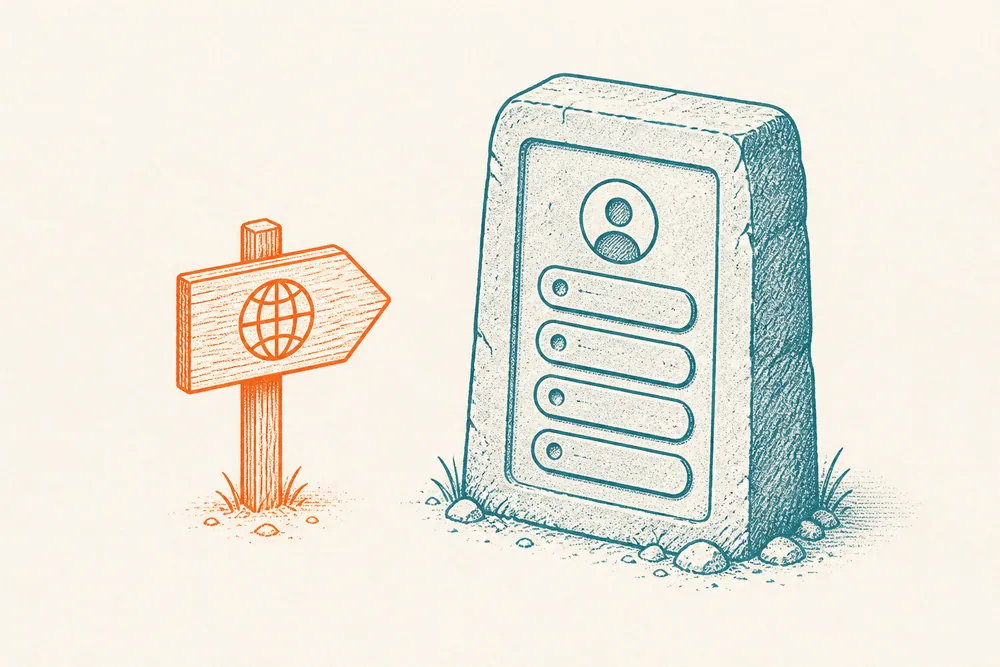
Link-in-bio pages are everywhere. Linktree, bio.link, carrd: a little page with your avatar and a stack of buttons. They are handy, and they all live on someone else's server, on someone else's terms, for as long as that company is around.
Mine lives on-chain: onchfs.io/@asbjornenge.com. Here is how it works, and how you can do the same.
1. Build a tiny static page
There is nothing special about the page itself. It is a folder with plain files:
linktree/
  index.html
  styles.css
  avatar.jpg
  github-brands-solid.svg
  spotify-brands-solid.svg
  youtube-brands-solid.svg
No framework, no build step, no JavaScript. The smaller and simpler it is, the cheaper it is to inscribe and the longer it will keep working. Use relative paths (href="styles.css", src="avatar.jpg") so the page works wherever it is served from.
2. Inscribe it with onchfs
onchfs is a file system that lives on a blockchain. Files are split into chunks, written to a contract, and the whole folder gets one content identifier, a CID, computed from what is in it.
With the onchfs command line tool:
npm install -g onchfs-cli
export ONCHFSCLI_TEZOS_PRIVATE_KEY=edsk...   # a separate wallet just for this
onchfs -n tezosx:mainnet put linktree/
It prints the CID of the folder. Mine is bd09cfd1…a42883. The page is now readable through any onchfs gateway:
https://tezosx.onchfs.io/<cid>/
https://onchfs.io/<cid>/
I use Tezos X here: storage costs a tiny fraction of Tezos L1, and a page like this is only a few kilobytes. Thanks to the patched contracts the CID is the same on every chain, so the same page inscribed on L1 has the same address.
3. Point your domain at it with DNS
A CID is not something you put on a business card. That is where DNS comes in. Add one TXT record to your domain:
_onchfs.example.com TXT "onchfs://<cid>"
The onchfs.io gateway looks for that record when you open https://onchfs.io/@example.com/. It reads the CID from DNS and serves the folder straight from the chain. That is all mine is: a TXT record on _onchfs.asbjornenge.com.
Updating it
The page itself can never change. That is the point. To update your links, change the folder, inscribe it again to get a new CID, and point the TXT record at the new one. @example.com now shows the new version.
The old version does not go anywhere. It is still on-chain under its old CID, a little time capsule of who you linked to in 2024.
What you get
- No account, no subscription, no platform. Nobody can change the terms, lock you out or shut it down.
- Your domain stays in charge. DNS decides which version is current, and you control your DNS.
- It keeps working. The files are on a public blockchain. Any onchfs gateway can serve them, including one you run yourself.
The only thing you have to keep paying for is the domain name. And even if that lapses one day, the page is still there, waiting at its CID.